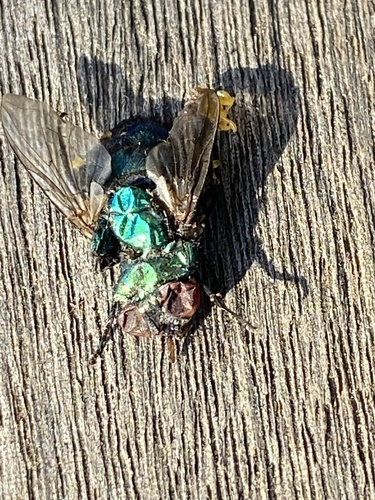
Lucilia coeruleiviridis, formerly Phaenecia coeruleiviridis, is commonly known as a green bottle fly, because of its metallic blue-green thorax and abdomen. L. coeruleiviridis was first discovered by French entomologist Pierre-Justin-Marie Macquart in 1855. It belongs to the family Calliphoridae and is one of many forensically important Diptera, as it is often found on decaying substances. L. coeruleiviridis is one of the most ubiquitous blow fly species in the southeastern United States, particularly in the spring and fall months.
From Wikipedia, under CC BY-SA 4.0.
Is it venomous or poisonous?
We have no record of Blue-green Bottle Fly being toxic, poisonous or venomous. That is not proof that it is safe. Never eat, touch or handle a wild plant, mushroom or animal on the strength of an identification; ask someone qualified.
Easily confused with
- Lucilia illustris
- Lucilia caesar
- Lucilia silvarum
- Lucilia sericata
- Hemipyrellia ligurriens
- Chrysomya albiceps
Classification
- Kingdom
- Animalia
- Phylum
- Arthropoda
- Class
- Insecta
- Order
- Diptera
- Family
- Calliphoridae
- Genus
- Lucilia
- Species
- Lucilia coeruleiviridis
Found one? Take a photo and B.inomen will suggest what it is, free.
Check your photo