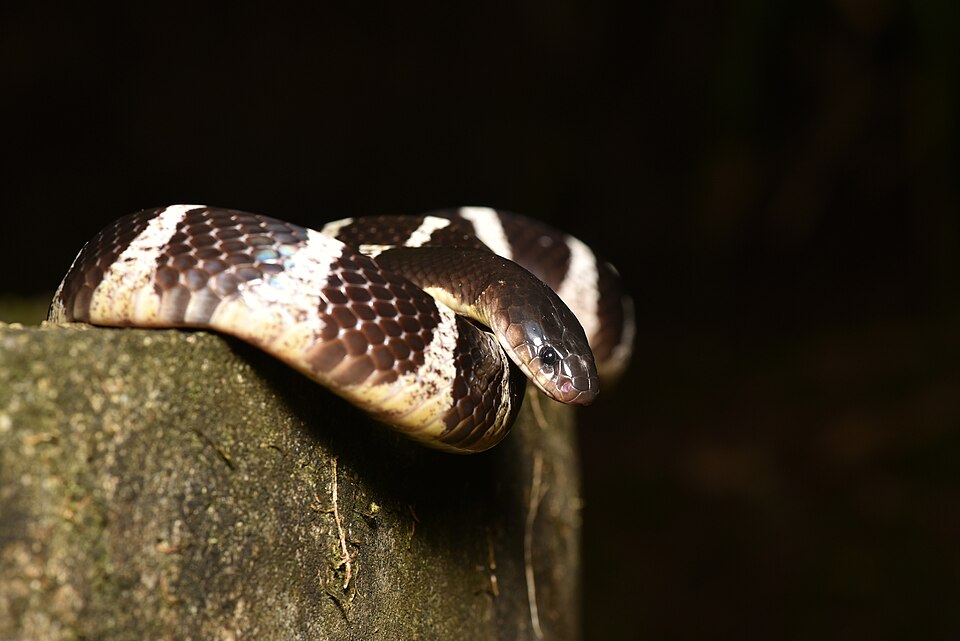

The many-banded krait (Bungarus multicinctus), also known as the Taiwanese krait or the Chinese krait, is an extremely venomous species of elapid snake found in much of central and southern China and Southeast Asia. The species was first described by the scientist Edward Blyth in 1861. Averaging 1 to 1.5 m (3.5 to 5 ft) in length, it is a black or bluish-black snake with many white bands across its body. The many-banded krait mostly inhabits marshy areas throughout its geographical distribution, though it does occur in other habitat types.
From Wikipedia, under CC BY-SA 4.0.
Is it venomous or poisonous?
Considered venomous. Public sources list it as such; we have not verified this individually. Never eat, touch or handle a wild plant, mushroom or animal on the strength of an identification; ask someone qualified.
Easily confused with
- Bungarus candidus — considered venomous
- Lycodon futsingensis
- Vermicella annulata — venomous
- Bungarus caeruleus — considered venomous
- Lycodon ruhstrati
Classification
- Kingdom
- Animalia
- Phylum
- Chordata
- Class
- Reptilia
- Order
- Squamata
- Family
- Elapidae
- Genus
- Bungarus
- Species
- Bungarus multicinctus
Found one? Take a photo and B.inomen will suggest what it is, free.
Check your photo