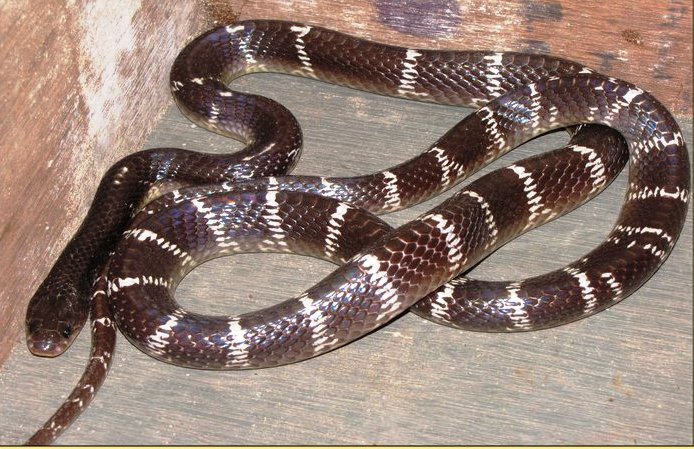

The common krait (Bungarus caeruleus) is a highly venomous snake species belonging to the genus Bungarus in the family Elapidae. It has a black or bluish-black body with narrow white crossbands, typically reaching a length of 0.91 to 1.22 m (3 to 4 ft). It is widely distributed across India, Pakistan, Bangladesh, Sri Lanka and Nepal, inhabiting grasslands, agricultural fields, and human settlements. It is known for its potent neurotoxic venom and responsible for the majority of medically significant snakebites in the Indian subcontinent.
From Wikipedia, under CC BY-SA 4.0.
Is it venomous or poisonous?
Considered venomous. Public sources list it as such; we have not verified this individually. Kraits (Bungarus spp.), including the common krait (Bungarus caeruleus) Never eat, touch or handle a wild plant, mushroom or animal on the strength of an identification; ask someone qualified.
Easily confused with
- Lycodon striatus
- Lycodon travancoricus
- Lycodon butleri
- Cylindrophis jodiae
- Lycodon aulicus
- Bungarus multicinctus — considered venomous
Classification
- Kingdom
- Animalia
- Phylum
- Chordata
- Class
- Reptilia
- Order
- Squamata
- Family
- Elapidae
- Genus
- Bungarus
- Species
- Bungarus caeruleus
Found one? Take a photo and B.inomen will suggest what it is, free.
Check your photo