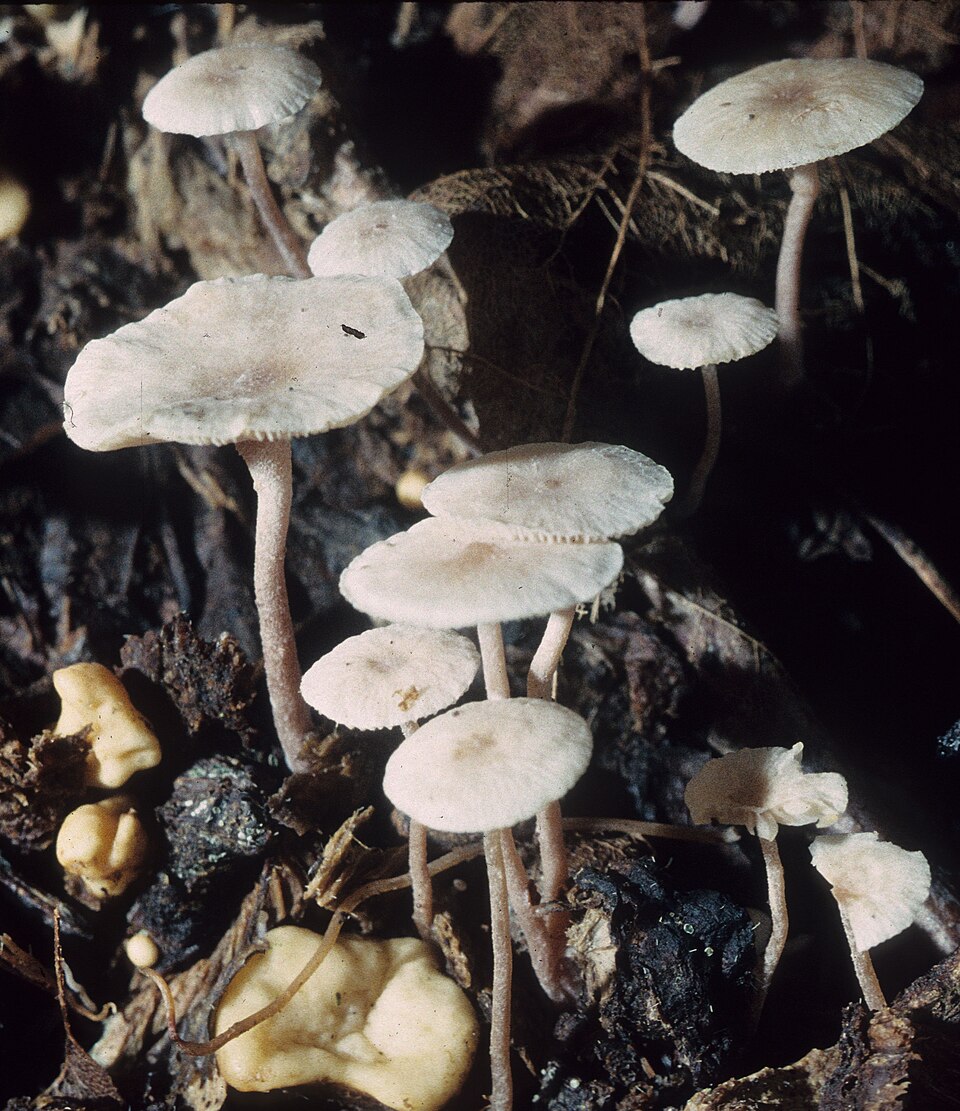

Collybia cookei, the split-pea shanklet, is a species of fungus in the family Tricholomataceae, and one of three species in the genus Collybia. It is known from Europe, Asia, and North America. The fungus produces fruit bodies that usually grow on the decomposing remains of other mushrooms, like Meripilus giganteus, Inonotus hispidus, or species of Russula; occasionally fruit bodies are found on rich humus or well-decayed wood. The fungus produces small white mushrooms with caps up to 9 mm (0.35 in) in diameter, supported by thin stems that originate from a yellowish-brown sclerotium.
From Wikipedia, under CC BY-SA 4.0.
Is it poisonous?
We have no record of Splitpea Shanklet being toxic, poisonous or venomous. That is not proof that it is safe. Never eat, touch or handle a wild plant, mushroom or animal on the strength of an identification; ask someone qualified.
Easily confused with
- Collybia tuberosa
- Collybia cirrhata
- Collybiopsis vaillantii
- Collybiopsis californica
- Resinomycena rhododendri
- Flammulaster carpophilus
Classification
- Kingdom
- Fungi
- Phylum
- Basidiomycota
- Class
- Agaricomycetes
- Order
- Agaricales
- Family
- Clitocybaceae
- Genus
- Collybia
- Species
- Collybia cookei
Found one? Take a photo and B.inomen will suggest what it is, free.
Check your photo