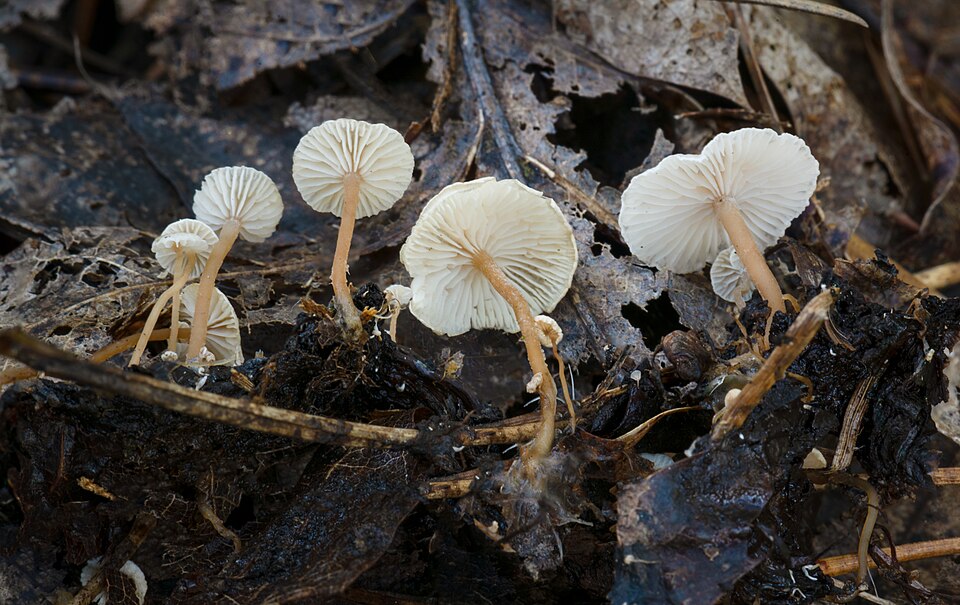

Collybia cirrhata, the piggyback shanklet, is a species of fungus in the family Tricholomataceae of the order Agaricales (gilled mushrooms). The species was first described in the scientific literature in 1786, but was not validly named until 1803. Found in Europe, Northern Eurasia, and North America, it is known from temperate, boreal, and alpine or arctic habitats. It is a saprobic species that grows in clusters on the decaying or blackened remains of other mushrooms. The fruit bodies are small, with whitish convex to flattened caps up to 11 mm (3⁄8 in) in diameter, narrow white gills, and slender whitish stems 8–25 mm (3⁄8–1 in) long and up to 2 mm (0.08 in) thick. C.
From Wikipedia, under CC BY-SA 4.0.
Is it poisonous?
We have no record of Piggyback Shanklet being toxic, poisonous or venomous. That is not proof that it is safe. Never eat, touch or handle a wild plant, mushroom or animal on the strength of an identification; ask someone qualified.
Easily confused with
- Collybia tuberosa
- Collybia cookei
- Collybiopsis californica
- Collybiopsis vaillantii
- Marasmiellus praeacutus
- Collybiopsis ramealis
Classification
- Kingdom
- Fungi
- Phylum
- Basidiomycota
- Class
- Agaricomycetes
- Order
- Agaricales
- Family
- Clitocybaceae
- Genus
- Collybia
- Species
- Collybia cirrhata
Found one? Take a photo and B.inomen will suggest what it is, free.
Check your photo