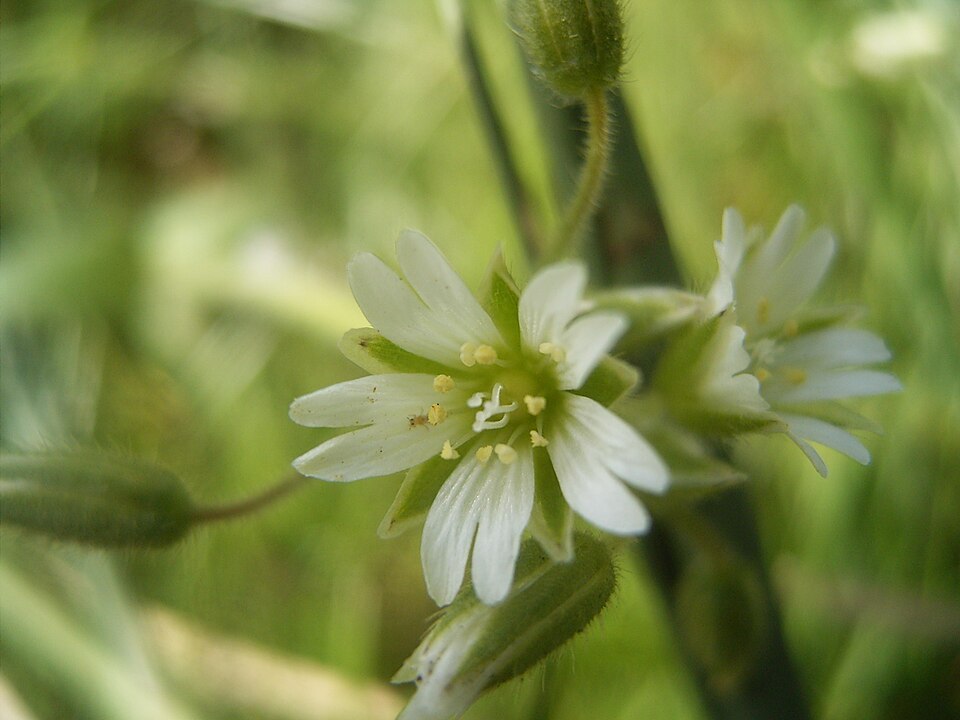

Cerastium fontanum, also called mouse-ear chickweed, common mouse-ear, or starweed, is a species of mat-forming perennial or, rarely, annual plant. It is native to Europe but introduced elsewhere. Its identifying characteristics are tear-shaped leaves growing opposite one another in a star pattern, hairy leaves, and small white flowers. Mouse-ear chickweed typically grows to 4"-8" tall and spreads horizontally along the ground via the formation of roots wherever the stem falls over and contacts the ground.
From Wikipedia, under CC BY-SA 4.0.
Is it poisonous?
We have no record of Common mouse-ear chickweed being toxic, poisonous or venomous. That is not proof that it is safe. Never eat, touch or handle a wild plant, mushroom or animal on the strength of an identification; ask someone qualified.
Easily confused with
- Cerastium holosteoides
- Cerastium semidecandrum
- Cerastium glomeratum
- Cerastium pumilum
- Cerastium capense
- Cerastium diffusum
Classification
- Kingdom
- Plantae
- Phylum
- Tracheophyta
- Class
- Magnoliopsida
- Order
- Caryophyllales
- Family
- Caryophyllaceae
- Genus
- Cerastium
- Species
- Cerastium fontanum
Found one? Take a photo and B.inomen will suggest what it is, free.
Check your photo