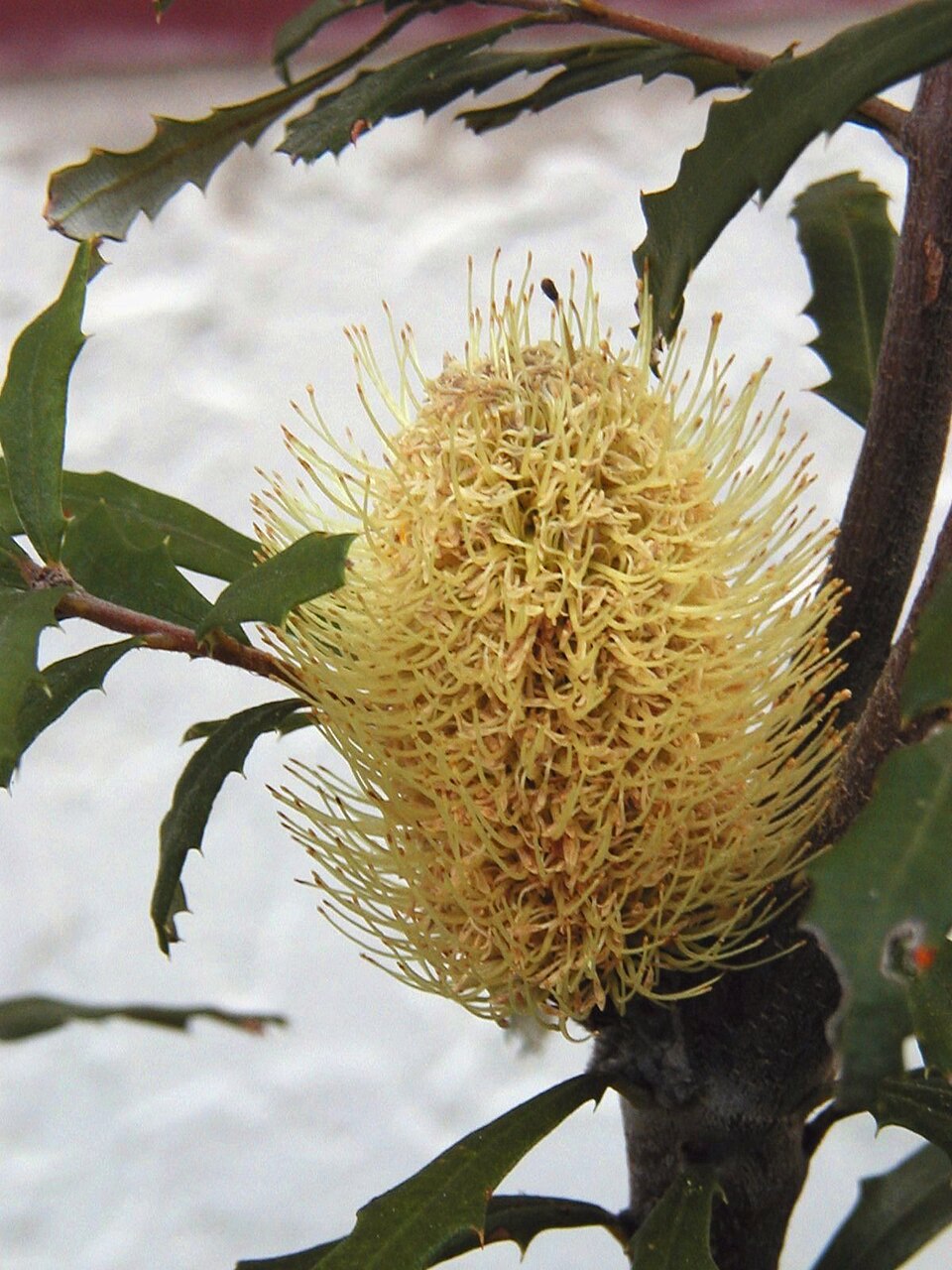

Banksia canei, commonly known as the mountain banksia, is a species of shrub that is endemic to southeastern Australia. It is generally encountered as a many-branched shrub that grows up to 3 m (10 ft) high, with narrow leaves and the yellow inflorescences (flower spikes) appearing from late summer to early winter. The old flowers fall off the spikes and up to 150 finely furred follicles develop, which remain closed until burnt in a bushfire. Each follicle bears two winged seeds. Response to fire is poorly known, although it is thought to regenerate by seed. Birds such as the yellow-tufted honeyeater and various insects forage among the flower spikes.
From Wikipedia, under CC BY-SA 4.0.
Is it poisonous?
We have no record of Mountain Banksia being toxic, poisonous or venomous. That is not proof that it is safe. Never eat, touch or handle a wild plant, mushroom or animal on the strength of an identification; ask someone qualified.
Easily confused with
- Banksia marginata
- Banksia seminuda
- Banksia neoanglica
- Banksia oblongifolia
- Banksia penicillata
- Banksia verticillata
Classification
- Kingdom
- Plantae
- Phylum
- Tracheophyta
- Class
- Magnoliopsida
- Order
- Proteales
- Family
- Proteaceae
- Genus
- Banksia
- Species
- Banksia canei
Found one? Take a photo and B.inomen will suggest what it is, free.
Check your photo