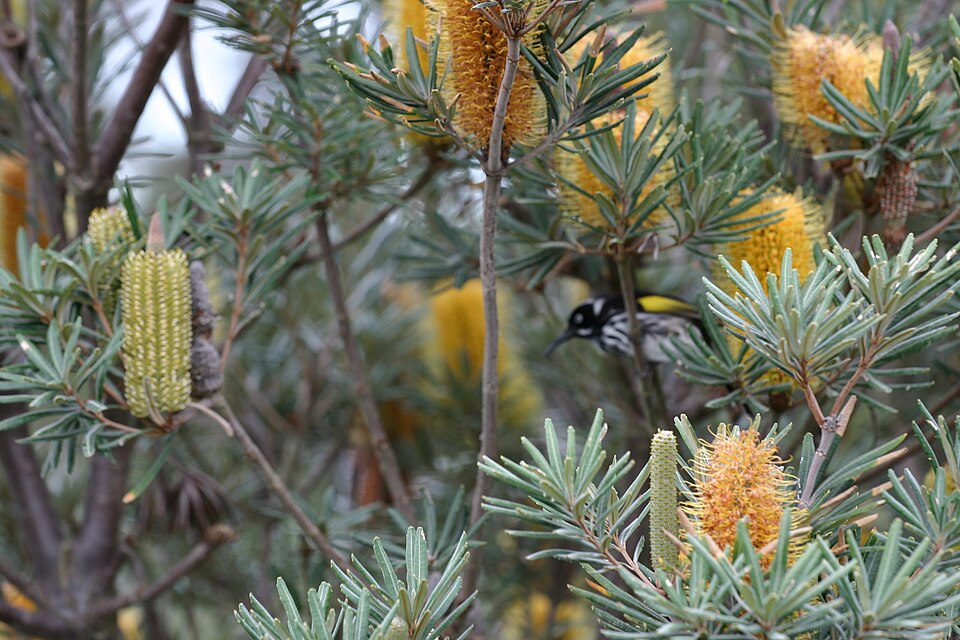

Banksia verticillata, commonly known as granite banksia or Albany banksia, is a species of shrub or (rarely) tree of the genus Banksia in the family Proteaceae. It is native to the southwest of Western Australia and can reach up to 3 m (10 ft) in height. It can grow taller to 5 m (16 ft) in sheltered areas, and much smaller in more exposed areas. This species has elliptic green leaves and large, bright golden yellow inflorescences or flower spikes, appearing in summer and autumn. The New Holland honeyeater (Phylidonyris novaehollandiae) is the most prominent pollinator, although several other species of honeyeater, as well as bees, visit the flower spikes.
From Wikipedia, under CC BY-SA 4.0.
Is it poisonous?
We have no record of Albany Banksia being toxic, poisonous or venomous. That is not proof that it is safe. Never eat, touch or handle a wild plant, mushroom or animal on the strength of an identification; ask someone qualified.
Easily confused with
Classification
- Kingdom
- Plantae
- Phylum
- Tracheophyta
- Class
- Magnoliopsida
- Order
- Proteales
- Family
- Proteaceae
- Genus
- Banksia
- Species
- Banksia verticillata
Found one? Take a photo and B.inomen will suggest what it is, free.
Check your photo